
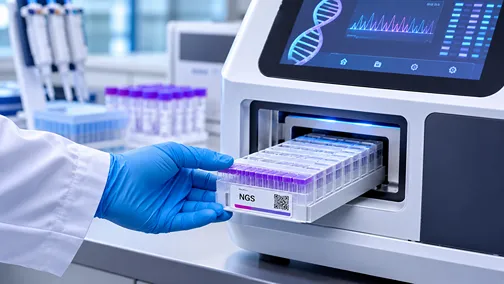
Many cancer patients today hear their oncologist recommend an “NGS test”. NGS, or next-generation sequencing, is a technology that reads the DNA, and sometimes RNA, of a tumour to find the genetic changes driving it. It has become one of the most important tools in modern cancer care because it can examine many genes at once from a single small sample.
How NGS works
Older genetic tests looked at one gene, or even one specific mutation, at a time. If the first test was negative, another test was ordered, using more tissue and more time. NGS works differently. The DNA from the tumour is broken into millions of small fragments, and all of them are read in parallel by a sequencing machine. Each part of the targeted genes is read many times over, so even changes present in a minority of the cells can be detected. Powerful software then compares the tumour’s DNA with a reference and identifies the differences.
Cancer NGS tests usually use a gene panel, ranging from a few dozen genes known to matter for a particular cancer to comprehensive panels of several hundred genes. Many panels also analyse RNA, which is better at detecting gene fusions such as ALK, ROS1, RET and NTRK.
What NGS can find
A single NGS test can detect several types of changes. These include point mutations such as EGFR or BRAF changes, gene amplifications such as extra copies of HER2 or MET, and gene fusions. Larger panels can also measure tumour mutational burden (TMB), the total number of mutations, and microsatellite instability (MSI), both of which help predict response to immunotherapy. Some tests assess homologous recombination deficiency (HRD), which guides PARP inhibitor treatment in ovarian and other cancers.
Results are typically sorted by how strong the evidence is for acting on them. The most important findings are those linked to an approved treatment for that cancer; others may point to clinical trials or have no current treatment implication.
Tissue or blood?
NGS is usually done on tumour tissue from a biopsy or surgery, stored in a paraffin block. The sample needs enough cancer cells, and well-preserved tissue gives the best results. When tissue is insufficient or a biopsy is risky, NGS can be done on a blood sample, called a liquid biopsy, which detects small fragments of tumour DNA circulating in the bloodstream. Liquid biopsy is quick and non-invasive, but it can miss changes when little tumour DNA is present, so a negative result may need confirmation on tissue.
How it helps patients
NGS helps match patients with targeted therapies and immunotherapy, identifies those who may benefit from clinical trials, and saves time and tissue compared with multiple single-gene tests. The European Society for Medical Oncology recommends routine NGS for several advanced cancers, including lung, prostate, ovarian and bile duct cancers, and its use is expanding.
Tumour NGS sometimes reveals a change that may be inherited, such as in BRCA1 or BRCA2. These findings need confirmation with a separate blood test and genetic counselling, because they affect relatives too.
Practical points
NGS results usually take one to three weeks. Not every patient needs a large panel, and not every finding leads to a treatment. Discuss with your oncologist which test is right for your cancer and stage, and what the results might change.