Non-Invasive Prenatal Testing (NIPT)

NIPT is a screening test that analyses cell-free DNA (cfDNA) in the mother's blood to assess the chance that the baby has certain chromosomal conditions.

Part of the cfDNA in maternal blood comes from the placenta and reflects the chromosomes of the pregnancy. The test needs only a maternal blood sample and carries no risk of miscarriage.
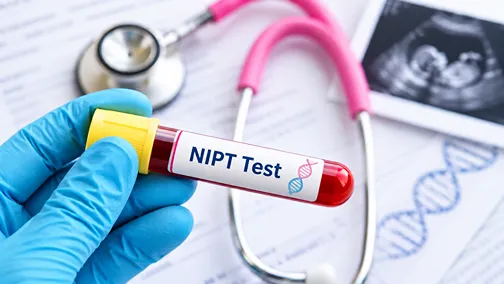
Non-Invasive Prenatal Testing (NIPT)
Sample 10 mL maternal blood in a cell-free DNA collection tube, from 10 weeks
Turnaround 5 to 7 working days from receipt of the sample
Method NGS of cell-free DNA from maternal plasma
Clinical Area Reproductive and Prenatal Genetics
Clinical Indications Method and Coverage Sample & Preparation Documents & Timing Limitations Results & Counselling Charges & Downloads

Clinical Indications

Screening, not diagnosis. NIPT is a screening test, not a diagnostic test. A high-chance NIPT result is not a diagnosis and should be confirmed by a diagnostic test.

  • Screening for common trisomies in any singleton or twin pregnancy from 10 weeks of gestation
  • High or intermediate chance result on first-trimester combined screening or the quadruple test
  • Advanced maternal age
  • Previous pregnancy affected by a trisomy
  • Parents who wish to avoid invasive testing as a first step

Method & Coverage

Conditions Screened

  • Trisomy 21 (Down syndrome)
  • Trisomy 18 (Edwards syndrome)
  • Trisomy 13 (Patau syndrome)
  • Sex chromosome aneuploidies, including Turner syndrome (45,X), Klinefelter syndrome (47,XXY), triple X (47,XXX) and 47,XYY

Method

Cell-free DNA is extracted from maternal plasma and analysed by next-generation sequencing. Sequence reads are mapped to each chromosome and compared with reference values to detect an excess or deficit of chromosomal material. The fetal fraction, the proportion of cfDNA from the placenta, is measured for every sample to ensure the result is reliable.

Performance

In published studies of singleton pregnancies, NIPT detects more than 99% of trisomy 21 pregnancies, around 98% of trisomy 18 and around 99% of trisomy 13, with a false-positive rate of about 0.1% for the three trisomies combined. Performance for sex chromosome aneuploidies is lower than for trisomy 21.

Sample & Preparation

  • Gestation: 10 weeks or more, confirmed by ultrasound.
  • Sample: 10 mL maternal whole blood in a cell-free DNA collection tube.
  • Transport: room temperature (15 to 25°C). Do not refrigerate or freeze.
  • Information required: gestational age, maternal weight, number of fetuses, IVF or donor egg pregnancy, and ultrasound findings.
See also general sample requirements and reasons samples may be rejected

Documents & Timing

Documents

  • Label every sample with at least two patient identifiers, matching the requisition form.
  • Include the completed requisition form, clinical information and signed consent.

Turnaround Time

5 to 7 working days from receipt of the sample.

Limitations

  • NIPT is a screening test, not a diagnostic test.
  • Because cfDNA comes from the placenta, a result may not reflect the fetus in cases of confined placental mosaicism.
  • Maternal chromosomal mosaicism, maternal malignancy, a vanishing twin, recent blood transfusion or organ transplant may cause discordant results.
  • It does not detect all chromosomal abnormalities, single-gene disorders, neural tube defects or structural anomalies.
  • High maternal weight is associated with lower fetal fraction and a higher chance of no result.

Results & Counselling

Interpreting results

  • Low chance: the pregnancy is very unlikely to be affected by the conditions screened. It does not exclude other genetic conditions or structural anomalies.
  • High chance: the pregnancy has an increased chance of the condition. Confirmation by CVS or amniocentesis is required before any decision is made about the pregnancy.
  • No result: occasionally a result cannot be issued, most often because the fetal fraction is low. A repeat sample is usually recommended.

How results are reported

Each report is prepared by a qualified scientist, reviewed independently and signed out by an authorised specialist. Reports state the test performed, the regions analysed, the result and its interpretation, recommendations for follow-up and the limitations of the test.

Report: A signed report is sent to the referring doctor.

Genetic Counselling

A genetic counsellor can explain what this test can and cannot show before it is done, and what the result means once it is available.

Charges & Downloads

Prices depend on the test and clinical situation. Ask our team for current price information.

Request Price Information